
All of the blog posts for my experience of the fire and losing our home have been transferred to Rocky Mountain Living blog.
Thanks,
Roland
Monday, March 7, 2011


Friday, September 3, 2010
Rehabilitating the Gothic Greenhouse
I have 3 Gothic greenhouses that I constructed pretty cheaply out of electrical conduit and clips. The construction information was published in an article with Maximum Yield (October 2008) and is also available on the Bountea website.
 The North greenhouse was in dire need of rehabilitation. In 2008, a snowfall of over 4 feet got wedged in the narrow pathway next to the greenhouse. The pressure of the snow pushed in the conduit ribs somewhat, though it continued to function fine. At long last, I got round to extending the greenhouse sideways (getting rid of the pathway) to incorporate a bottle wall that will add thermal mass.
I re-bent the conduit ribs and attached them to the bottle wall. Now I am rebuilding the end walls to enclose everything. I intend to create a 2 foot wide cold frame against the bottle wall so that my winter plants will get a little extra warmth. More later.

I re-bent the conduit ribs and attached them to the bottle wall. Now I am rebuilding the end walls to enclose everything. I intend to create a 2 foot wide cold frame against the bottle wall so that my winter plants will get a little extra warmth. More later.
Monday, August 9, 2010
Late Harvest
It has been a slow summer in the vegetable garden. Except for a 2 week period of severe heat, it has been generally cool after a very cold spring. The tomatoes are only just getting going; some plants do not even have flowers. I still have no peppers, cucumbers or summer squash and the beans are just beginning to set.
The cool weather crops are naturally doing better than usual: I just harvested the last of the peas; the fava beans are still cropping; the cabbages, turnips and carrots are sweet. Last nigh we ate a medley of sauteed peas, tiny beans, carrots and rutabaga - yum!
The cool weather crops are naturally doing better than usual: I just harvested the last of the peas; the fava beans are still cropping; the cabbages, turnips and carrots are sweet. Last nigh we ate a medley of sauteed peas, tiny beans, carrots and rutabaga - yum!
Opening the Garden

It rained and rained and the temperature dropped down into the 50's! Still, the hollyhocks made a brave showing, snacks were consumed and I learned more about the amazing resilience of bindweed.
Garlic
I rather overdid planting garlic last year - a full 6' x 4' bed closely planted. Unfortunately, we took a trip to California just when the garlic was ready for harvest. By the time we came back, all the stems had shriveled and the cloves were bursting out of their skins.
 Digging the garlic without stems is a real pain and with little skins protection, the cloves are unlikely to last into the winter. On the positive side, the skins simply dropped off and the cloves were extremely easy to peel. Now we have bags of garlic in the freezer, roast garlic paste in the fridge and a big jar of pickled garlic. The trug (English garden basket) pictured is what we have left after giving lots to friends.
The garlic bed is newly seeded with spelt and buckwheat. By September, it will be ready for winter crops.

The garlic bed is newly seeded with spelt and buckwheat. By September, it will be ready for winter crops.
San Francisco Indoor Gradening Expo
On the last weekend in July San Francisco hosted the biggest hydroponics and organic gardening show in the country. This year, Organic Bountea shared a booth with our distributor, Humboldt Wholesale. With the support of Humboldt Wholesale, Bountea products are now carried by nearly 100 stores across the country.
Look for stores carrying the full line of our products under STORE LOCATOR on the Bountea website.
Look for stores carrying the full line of our products under STORE LOCATOR on the Bountea website.
Thursday, June 17, 2010
Big Changes

Part of the reasons for the trip was discussions with a Dutch distributor of compost tea systems who will be carrying Bountea products in Europe. That will hopefully happen before the end of the year. Every few days we get requests from Ireland, Sweden, Portugal and even Turkey for our products. It will be satisfying to be able to provide what people want and need.
At the beginning of June, Organic Bountea moved to a bigger and better warehouse and facilities near Sebastopol in California. It is beautiful wine country with just the kind of environment we were looking for: quiet and peaceful but close enough to main trucking routes. We are settling in and working hard to get production back up to speed.
As Lao Tzu possibly said: "Moving is natural, stagnation is sickness."
Thursday, May 13, 2010
Sutherlands Mother's Day Plant Sale
They call it, "Punching for Posies" - 3,000 revved up gardeners lined up to get the best deals in bedding plants, perennials and veggie starts at Sutherlands Mother's Day plant sale. To calm the competitive spirit, music and food were provided; a well-organized system of tickets and payment kept it all moderately under control.
Bountea had a strong presence, handing out samples of SuperStart and educating some of the "bedding-planters" into the wonders of organic growing and compost tea. It still surprises me that only about 1 in 20 of Boulder residents has any interest or concern for their soil. For the vast majority, it is stick in the plant and dump on the Miracle Grow! Still, a few of those standing in line took the time to talk with myself or Stacey.
Person by person, gardeners are slowly taking more care of their soil ecology.
Bountea had a strong presence, handing out samples of SuperStart and educating some of the "bedding-planters" into the wonders of organic growing and compost tea. It still surprises me that only about 1 in 20 of Boulder residents has any interest or concern for their soil. For the vast majority, it is stick in the plant and dump on the Miracle Grow! Still, a few of those standing in line took the time to talk with myself or Stacey.
Person by person, gardeners are slowly taking more care of their soil ecology.
Cleaning the Pond


The pond was a mess. After the long winter and recent 80 mph winds, it was full of pine needles, pieces of paper and a bunch of plastic plant pots. I had not deep-cleaned it for about 5 years, so the bottom was covered with smelly black gunk and reed roots.
I pumped out as much water as possible, took off my jeans and plunged into the muck up to my knees. After doing basic cleaning, a heroic battle ensued with the hydra roots of the water lilly. From a tiny pot, it had grown to a 3 ft square slimy mass weighing 50 lb or more. Sword in hand, I chopped it down to a mere 30 lb solid block and refilled with clean clear water.
The pictures are from fall and early spring last year.
Monday, May 3, 2010
Gray-water Irrigation System
The snow has finally melted and the frosts are intermittent, so it is time to redo the greenhouse watering system.
 Water from the roof, showers and the clothes washer is collected in a 200 gallon tank. I have diverter valves on the drain pipes in the crawl space that I turn on in the Spring and off in the Winter.
From the tank, the gray-water is filtered and travels underground to each of the 3 greenhouses via a 1" plastic pipe. Each greenhouse has a shutoff to isolated the 1/2" distribution pipe that channels the water to the t-tape (flat drip tape) that runs the length of each greehouse bed.
This weekend, I cleaned out the supply pipes by attaching them to a pressurized hose, checked the filter system and started laying new t-tape. I was excited because i had found some t-tape with 4 inch spaced emitters made especially for greenhouses.
Unfortunately, once I had cut the the tape to the right lengths, set them up nicely and turned on the water, I found the company, Rain-Flo Irrigation had sent me t-tape with 12" spaced emitters. They refused to credit me for the unused portion, so I am stuck with them.
Such is dealing with companies with poor customer service! I will get the right stuff and try again when I have time.

From the tank, the gray-water is filtered and travels underground to each of the 3 greenhouses via a 1" plastic pipe. Each greenhouse has a shutoff to isolated the 1/2" distribution pipe that channels the water to the t-tape (flat drip tape) that runs the length of each greehouse bed.
This weekend, I cleaned out the supply pipes by attaching them to a pressurized hose, checked the filter system and started laying new t-tape. I was excited because i had found some t-tape with 4 inch spaced emitters made especially for greenhouses.
Unfortunately, once I had cut the the tape to the right lengths, set them up nicely and turned on the water, I found the company, Rain-Flo Irrigation had sent me t-tape with 12" spaced emitters. They refused to credit me for the unused portion, so I am stuck with them.
Such is dealing with companies with poor customer service! I will get the right stuff and try again when I have time.
Bountea and Wonder Soil
Organic Bountea and Wonder Soil, a company out of Las Vegas, are partnering in the development of new products. Wonder Soil has a great line of compressed coir based (coconut fiber) products that expand as much as 9 times when water is added. I am testing a mix of coir and Humisoil for germination growth rates. Many of the seeds popped out of the soil mix in 2 days! Expect to see Bountea Wonder Soil on the website within a few months.
I am not a good researcher and get impatient with comparative trials. It is strange not to give each of my plants the best nurturing I can provide. When I see a plant not thriving, I automatically reach for some remedy -- and spoil the trial!
I am not a good researcher and get impatient with comparative trials. It is strange not to give each of my plants the best nurturing I can provide. When I see a plant not thriving, I automatically reach for some remedy -- and spoil the trial!
Monday, April 26, 2010
Supporting Peas
The peas are about 2" - 6" and in need of support. I have tried all sorts of methods: the English traditional methods are twiggy branches or mesh netting. I don't like either as they are messy and hard to reuse.
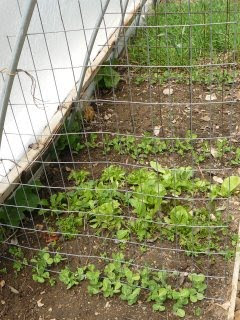 After a lot of experimentation, I use a rather stiff metal mesh 4 feet high, that I stick into the ground and either tie to greenhouse ribs or to long stakes. The mesh is fairly cheap, easy to clean and lasts indefinitely. The peas seem to love it and crops are heavier and longer.
Do not listen to those seed companies that say you do not need to support dwarf pea varieties. Peas love to climb and the higher the better.

Do not listen to those seed companies that say you do not need to support dwarf pea varieties. Peas love to climb and the higher the better.
Foaming Bountea

I believe foam is a great indicator of biological activity and am told it contains the bodies of dead microbes!
I have heard that some "experts" say the foam comes from the yucca in the Bioactivator. This does not quite make sense as it only happens when it is warm and has been brewing for a few hours.
If you want to reduce foaming, just add a little cooking oil to the brew.
Digging in the Garden
I was away over the last week and could not get into the garden. So this last weekend was a bit of a marathon.
I found that some strange roots (possibly aspen) had invaded some greenhouse beds and created a interlaced network about 9" below the surface. Out came the Big fork (10" tines while the Little fork has 5" tines) and I had an energetic time getting most of the roots out.
Although I espouse minimal dig methods which only disturb the top 4 inches of the soil, I actually love to dig! I was raised on double-digging that goes down 18" but that is not a good idea in my sandy soil. So I create new beds (like the potatoes) or renovate the old ones as an excuse to get some real exercise. I have my eye on a new patch for next week!
I found that some strange roots (possibly aspen) had invaded some greenhouse beds and created a interlaced network about 9" below the surface. Out came the Big fork (10" tines while the Little fork has 5" tines) and I had an energetic time getting most of the roots out.
Although I espouse minimal dig methods which only disturb the top 4 inches of the soil, I actually love to dig! I was raised on double-digging that goes down 18" but that is not a good idea in my sandy soil. So I create new beds (like the potatoes) or renovate the old ones as an excuse to get some real exercise. I have my eye on a new patch for next week!
Tuesday, April 13, 2010
Potatoes
I have a complicated relationship with potatoes. When I was 18 and living on a tiny croft farm on the Sheepshead Penninsula in the far South of Ireland, we planted potatoes in lazy-beds every year (see Bountea Article). With the rain, peaty soil and a helping of cow manure, the potatoes simply grew themselves.
In my sandy alkali soil, I have had problems getting any kind of crop - and the potatoes often have a nasty dose of scab. Last year I grew a couple of varieties of fingerlings with moderate success. I dug deep trenches and filled them with peatmoss and pine tree mulch. The more acid environment did help contain the scab.
This Sunday I started two new beds; potatoes like fresh soil. I had forgotten how rocky my soil can be as I removed about 60 pounds of stones from an area 30" x 60". I am trying the car tire approach: you plant 2 or 3 potatoes and cover with a car tire. As the plant grows, you fill in the tire with more mulch and soil around the stem to provide an environment for the setting of extra potatoes. There is a concern that the tires might leach chemicals but I will use weed block to keep the roots from touching the rubber.
I contacted the seed potato supplier, Ronniger Potato Farm, and asked for scab resistant varieties. Of their suggestions, I ordered Keuka Gold. I also planted Peanut fingerlings for great taste. Ronnigers also told me that I was probably not watering enough and the dry soil was promoting scab.
With better information and a few new growing tricks, I expect to a bumper crop of potatoes this year.
In my sandy alkali soil, I have had problems getting any kind of crop - and the potatoes often have a nasty dose of scab. Last year I grew a couple of varieties of fingerlings with moderate success. I dug deep trenches and filled them with peatmoss and pine tree mulch. The more acid environment did help contain the scab.
This Sunday I started two new beds; potatoes like fresh soil. I had forgotten how rocky my soil can be as I removed about 60 pounds of stones from an area 30" x 60". I am trying the car tire approach: you plant 2 or 3 potatoes and cover with a car tire. As the plant grows, you fill in the tire with more mulch and soil around the stem to provide an environment for the setting of extra potatoes. There is a concern that the tires might leach chemicals but I will use weed block to keep the roots from touching the rubber.
I contacted the seed potato supplier, Ronniger Potato Farm, and asked for scab resistant varieties. Of their suggestions, I ordered Keuka Gold. I also planted Peanut fingerlings for great taste. Ronnigers also told me that I was probably not watering enough and the dry soil was promoting scab.
With better information and a few new growing tricks, I expect to a bumper crop of potatoes this year.
Mountain Gardeners Meeting
The food was wonderful, the conversation all about gardening - what could be better! The Boulder Mountain Organic Gardeners had their first meeting with just 10 members - but a whole host waiting in the wings. The conversation ranged over topics of intense interest to mountain gardeners:
- Plant protection vs. the devastation of hail, wind and critters
- Pollination by other insects than bees
- Which varieties of vegetable grow best at altitude and in short seasons
- How to get our rocky soil to become and stay fertile
- Project Budburst (www.budburst.org) - keeping exact records on plant development to help track climate change for UCAR in Boulder
- Encouraging the growth of aspens using wood-ash -- but make sure keep them far from your garden!
Tuesday, April 6, 2010
Preparing for Spring with Microbes
Not a very interesting weekend in the garden - mostly clean-up after the snow and getting ready for the burst of growth that will happen as soon as it stops freezing at night.
I sowed more cover crops (peas and barley), planted out the leeks and transplanted lots of Swiss chard seedlings that had set themselves. The variety is my favorite - Verte a Carde Blanche - very sweet with a wide white stem and slightly crumpled deep green leaves. We use the leaves and stem as almost separate vegetables.
 I ran a bunch of Fall leaves through the shredder ready for another compost pile. The old pile had cooled down so I turned it over, added a couple of handfuls of rock dust, some M3 and a good dose of Bountea. The extra nitrogen and microbes really worked - in a couple of days it was steaming hot again.
It is always best to add all amendments, particularly rock dust, to either the Bountea or your compost pile. That way everything gets processed by the microbes. Microbes are king of the garden. The picture is of microbes in compost tea.
I sowed more cover crops (peas and barley), planted out the leeks and transplanted lots of Swiss chard seedlings that had set themselves. The variety is my favorite - Verte a Carde Blanche - very sweet with a wide white stem and slightly crumpled deep green leaves. We use the leaves and stem as almost separate vegetables.

It is always best to add all amendments, particularly rock dust, to either the Bountea or your compost pile. That way everything gets processed by the microbes. Microbes are king of the garden. The picture is of microbes in compost tea.
Friday, April 2, 2010
Green Manure for Tomatoes
This is the right time to begin thinking about your tomato beds. I am not exactly sure where all the varieties will fit but I know they like lots of food. I had 15 minutes to spare today, so I sowed some green manure in a couple of places.
 I gave the 2 beds (each 4' x 6') a shallow forking and raked them smooth. This year I am experimenting with Field Peas and Spelt. I usually use clover and barley but I wanted a change. The big seeds are easily sprinkled over the soil. I gently raked them in and covered with a light dusting of leaves. That's it.
The seeds should germinate quickly with the peas climbing up the spelt stems as they grow. In May/June, I will fork them under and plant the tomatoes.

The seeds should germinate quickly with the peas climbing up the spelt stems as they grow. In May/June, I will fork them under and plant the tomatoes.
Boulder Mountain Organic Gardeners
I have been a member of the Boulder Culinary Gardeners (BCG) for a number of years. It is wonderful collection of avid vegetable gardeners with a vast range of experience. Lately the group has become so popular that it has been hard to hold meetings of the whole group. Instead it now provides classes on a number of gardening topics to all comers.
 One difficulty I have with BCG is that members mostly garden in the Boulder flatlands at around 5,500 altitude. That means they enjoy an unfair growing advantage over us Mountain gardeners. The season is shortened by about 10 days for every 1000 ft altitude; my last frost date can be June 1st. The picture is of the path to my greenhouses.
So a few of us hardy Mountain gardeners have got together to start our own group: Boulder Mountain Organic Gardeners (BMOG). We hope to hold our first big meeting in a couple of weeks. You have to be crazy to garden in the Rocky Mountains so it should be interesting!
If you are a gardener, think about joining or forming your own group. It is an immensely valuable arena to share gardening experiences. Tell me about your.

So a few of us hardy Mountain gardeners have got together to start our own group: Boulder Mountain Organic Gardeners (BMOG). We hope to hold our first big meeting in a couple of weeks. You have to be crazy to garden in the Rocky Mountains so it should be interesting!
If you are a gardener, think about joining or forming your own group. It is an immensely valuable arena to share gardening experiences. Tell me about your.
Tuesday, March 30, 2010
Why Do We Garden? #2
Gardening is never done, is never complete, is never totally under control. To garden is to inhabit a world where the need to create order, design, form comes up against the forces of chaos, unpredictability and serendipity. We have to face the fact that we are attempting to impose our will on a patch of ground - and it will resist.
This is not because nature is ‘bloody-minded’. It is more that we are part of a universe that is neither totally orderly nor totally disordered. In technical terms, the universe and our garden, are “chaotic”. As we try to impose order, it will inject the unpredictable - not do exactly as it is told. In this way, gardens are a bit like adolescent children: they naturally resist parental control but will sometimes comply if cajoled, encouraged, nagged or screamed at.
A gardener has to be an intelligent, loving and firm parent figure to the forces of nature that wish to grow wild and free. Maybe the gardening personality is one in which the need to to have control is balanced with the need for acceptance. Maybe the gardener is one who is seeking to come to terms with the universal laws of chaos. Are you involved in the struggle between order and chaos?
This is not because nature is ‘bloody-minded’. It is more that we are part of a universe that is neither totally orderly nor totally disordered. In technical terms, the universe and our garden, are “chaotic”. As we try to impose order, it will inject the unpredictable - not do exactly as it is told. In this way, gardens are a bit like adolescent children: they naturally resist parental control but will sometimes comply if cajoled, encouraged, nagged or screamed at.
A gardener has to be an intelligent, loving and firm parent figure to the forces of nature that wish to grow wild and free. Maybe the gardening personality is one in which the need to to have control is balanced with the need for acceptance. Maybe the gardener is one who is seeking to come to terms with the universal laws of chaos. Are you involved in the struggle between order and chaos?
Subscribe to:
Posts (Atom)


 Posts
Posts

