
It has been a slow summer in the vegetable garden. Except for a 2 week period of severe heat, it has been generally cool after a very cold spring. The tomatoes are only just getting going; some plants do not even have flowers. I still have no peppers, cucumbers or summer squash and the beans are just beginning to set.
The cool weather crops are naturally doing better than usual: I just harvested the last of the peas; the fava beans are still cropping; the cabbages, turnips and carrots are sweet. Last nigh we ate a medley of sauteed peas, tiny beans, carrots and rutabaga - yum!
Showing posts with label Vegetables. Show all posts
Showing posts with label Vegetables. Show all posts
Monday, August 9, 2010


Garlic
I rather overdid planting garlic last year - a full 6' x 4' bed closely planted. Unfortunately, we took a trip to California just when the garlic was ready for harvest. By the time we came back, all the stems had shriveled and the cloves were bursting out of their skins.
 Digging the garlic without stems is a real pain and with little skins protection, the cloves are unlikely to last into the winter. On the positive side, the skins simply dropped off and the cloves were extremely easy to peel. Now we have bags of garlic in the freezer, roast garlic paste in the fridge and a big jar of pickled garlic. The trug (English garden basket) pictured is what we have left after giving lots to friends.
The garlic bed is newly seeded with spelt and buckwheat. By September, it will be ready for winter crops.

The garlic bed is newly seeded with spelt and buckwheat. By September, it will be ready for winter crops.
Monday, April 26, 2010
Supporting Peas
The peas are about 2" - 6" and in need of support. I have tried all sorts of methods: the English traditional methods are twiggy branches or mesh netting. I don't like either as they are messy and hard to reuse.
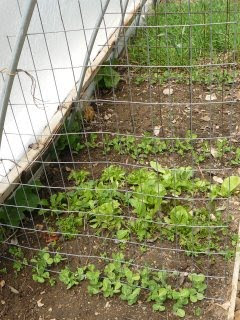 After a lot of experimentation, I use a rather stiff metal mesh 4 feet high, that I stick into the ground and either tie to greenhouse ribs or to long stakes. The mesh is fairly cheap, easy to clean and lasts indefinitely. The peas seem to love it and crops are heavier and longer.
Do not listen to those seed companies that say you do not need to support dwarf pea varieties. Peas love to climb and the higher the better.

Do not listen to those seed companies that say you do not need to support dwarf pea varieties. Peas love to climb and the higher the better.
Tuesday, April 13, 2010
Potatoes
I have a complicated relationship with potatoes. When I was 18 and living on a tiny croft farm on the Sheepshead Penninsula in the far South of Ireland, we planted potatoes in lazy-beds every year (see Bountea Article). With the rain, peaty soil and a helping of cow manure, the potatoes simply grew themselves.
In my sandy alkali soil, I have had problems getting any kind of crop - and the potatoes often have a nasty dose of scab. Last year I grew a couple of varieties of fingerlings with moderate success. I dug deep trenches and filled them with peatmoss and pine tree mulch. The more acid environment did help contain the scab.
This Sunday I started two new beds; potatoes like fresh soil. I had forgotten how rocky my soil can be as I removed about 60 pounds of stones from an area 30" x 60". I am trying the car tire approach: you plant 2 or 3 potatoes and cover with a car tire. As the plant grows, you fill in the tire with more mulch and soil around the stem to provide an environment for the setting of extra potatoes. There is a concern that the tires might leach chemicals but I will use weed block to keep the roots from touching the rubber.
I contacted the seed potato supplier, Ronniger Potato Farm, and asked for scab resistant varieties. Of their suggestions, I ordered Keuka Gold. I also planted Peanut fingerlings for great taste. Ronnigers also told me that I was probably not watering enough and the dry soil was promoting scab.
With better information and a few new growing tricks, I expect to a bumper crop of potatoes this year.
In my sandy alkali soil, I have had problems getting any kind of crop - and the potatoes often have a nasty dose of scab. Last year I grew a couple of varieties of fingerlings with moderate success. I dug deep trenches and filled them with peatmoss and pine tree mulch. The more acid environment did help contain the scab.
This Sunday I started two new beds; potatoes like fresh soil. I had forgotten how rocky my soil can be as I removed about 60 pounds of stones from an area 30" x 60". I am trying the car tire approach: you plant 2 or 3 potatoes and cover with a car tire. As the plant grows, you fill in the tire with more mulch and soil around the stem to provide an environment for the setting of extra potatoes. There is a concern that the tires might leach chemicals but I will use weed block to keep the roots from touching the rubber.
I contacted the seed potato supplier, Ronniger Potato Farm, and asked for scab resistant varieties. Of their suggestions, I ordered Keuka Gold. I also planted Peanut fingerlings for great taste. Ronnigers also told me that I was probably not watering enough and the dry soil was promoting scab.
With better information and a few new growing tricks, I expect to a bumper crop of potatoes this year.
Monday, March 29, 2010
Peas, Carrots and Parsnips
Two feet of snow this week - time to dig another path to the greenhouses!
March is an important month for sowing cool weather seeds for a mid summer crop, so there is some pressure to get stuff in. I have a row of early sown peas just coming up, but there can never be too many. We eat the snow and sugar snaps in salads or straight off the vine. The pod peas we consider special food as they are less prolific at this altitude.

I plant peas in the cool greenhouse; shading extends their flowering and cropping into late summer. When the snow melts, I will plant a later crop in the garden beds. I had sown a January cover crop of rye in the greenhouse and I simply turned the 5" purplish leaves into the soil. Peas are planted 1/2" deep in three rows about 3" apart every way (I sow each row offset from the others to save room). I always protect with a floating row cover in case mice and voles eat the tender shoots.
Peas
Mammoth Melting Snow - the earliest, very prolific and hardy and keeps cropping until it gets hot
Cascadia Snap - a small bushy sweet snap that did well last year when planted late and neglected
Sugarsnap Snap - our favorite, with the plump sugary pods that are just wonderful
Mr Big Pea - big pods with lots of peas that have a large pea floury flavor
Mayfair Pea - smaller bushy sweeter variety of pod pea.
I believe all pea vines need to be supported. The bushy varieties will double their crop if they have something to climb on and will not get so many diseases. I will talk about support suggestions later.
Peas and carrots are good companions, so I planted rows of carrots between the peas. The peas shade the carrots a little but will be finished before the carrots are ready to crop.
Carrots
Scarlet Nantes - our favorite, very tasty, especially in the Fall
Red Cored Chantenay - a pretty-looking tasty variety that keeps well over the winter
Atomic Red - did OK last year but not a favorite
St Valery - new this year
Yaya - new this year, love the name!
Danvers Half Long - good reliable variety
Parsnips
I always plant parsnips though they can be tricky to get started; the seeds are very slow to germinate. Harris Model is a so-so variety but often the only one available. I found a very nice Biodynamic variety some time ago (forgot the name) and am planting my own seeds from it. Parsnips are planted like chard and beets - 3 seeds about 3" - 4" apart and then thin out the weaker plants.
March is an important month for sowing cool weather seeds for a mid summer crop, so there is some pressure to get stuff in. I have a row of early sown peas just coming up, but there can never be too many. We eat the snow and sugar snaps in salads or straight off the vine. The pod peas we consider special food as they are less prolific at this altitude.

I plant peas in the cool greenhouse; shading extends their flowering and cropping into late summer. When the snow melts, I will plant a later crop in the garden beds. I had sown a January cover crop of rye in the greenhouse and I simply turned the 5" purplish leaves into the soil. Peas are planted 1/2" deep in three rows about 3" apart every way (I sow each row offset from the others to save room). I always protect with a floating row cover in case mice and voles eat the tender shoots.
Peas
Mammoth Melting Snow - the earliest, very prolific and hardy and keeps cropping until it gets hot
Cascadia Snap - a small bushy sweet snap that did well last year when planted late and neglected
Sugarsnap Snap - our favorite, with the plump sugary pods that are just wonderful
Mr Big Pea - big pods with lots of peas that have a large pea floury flavor
Mayfair Pea - smaller bushy sweeter variety of pod pea.
I believe all pea vines need to be supported. The bushy varieties will double their crop if they have something to climb on and will not get so many diseases. I will talk about support suggestions later.
Peas and carrots are good companions, so I planted rows of carrots between the peas. The peas shade the carrots a little but will be finished before the carrots are ready to crop.
Carrots
Scarlet Nantes - our favorite, very tasty, especially in the Fall
Red Cored Chantenay - a pretty-looking tasty variety that keeps well over the winter
Atomic Red - did OK last year but not a favorite
St Valery - new this year
Yaya - new this year, love the name!
Danvers Half Long - good reliable variety
Parsnips
I always plant parsnips though they can be tricky to get started; the seeds are very slow to germinate. Harris Model is a so-so variety but often the only one available. I found a very nice Biodynamic variety some time ago (forgot the name) and am planting my own seeds from it. Parsnips are planted like chard and beets - 3 seeds about 3" - 4" apart and then thin out the weaker plants.
Sunday, March 21, 2010
Planting Tomato Varieties
I am late planting tomato seeds inside. Last Friday, I made up another batch of starting mix (coir, Humisoil, sand) with a little SuperStart and added a bit of M3, as tomatoes are heavy feeders. The 2 1/2" seed containers are a good size and I put one seed in each containers -- about 6 plants of each variety.
Tomatoes are easy to germinate and I always have too many plants for my greenhouses - so I sell, swap or give away the extra. Here is what I planted this year.
 Prudens Purple: our favorite - large, late, heavy cropping, extraordinary vivid taste, deep pink P
Cherokee Purple: great taste, green/purple, medium large F
Aunt Ruby's German Green: new this year P
Glacier: very hardy and early, medium size, OK taste F
Sun Gold: the standard gold cherry, heavy cropping, reliable, sweet F
Gold Nugget: determinate, sweet, gold bush cherry - great for the deck containers P
Black Cherry: new this year P
Martinos Roma: new this year P
Black Plumb: favorite plumb - dark, tasty, good for drying (from a friend)
Orange ?: a variety given by a friend
I also planted some peppers and an eggplant. I do not do well with them but keep trying different varieties.
Fooled You: new this year P
Klari Baby Cheese: new this year F
Napoleon: new this year P
Swallow Eggplant: new this year F
Tomatoes are easy to germinate and I always have too many plants for my greenhouses - so I sell, swap or give away the extra. Here is what I planted this year.

Cherokee Purple: great taste, green/purple, medium large F
Aunt Ruby's German Green: new this year P
Glacier: very hardy and early, medium size, OK taste F
Sun Gold: the standard gold cherry, heavy cropping, reliable, sweet F
Gold Nugget: determinate, sweet, gold bush cherry - great for the deck containers P
Black Cherry: new this year P
Martinos Roma: new this year P
Black Plumb: favorite plumb - dark, tasty, good for drying (from a friend)
Orange ?: a variety given by a friend
I also planted some peppers and an eggplant. I do not do well with them but keep trying different varieties.
Fooled You: new this year P
Klari Baby Cheese: new this year F
Napoleon: new this year P
Swallow Eggplant: new this year F
Do you have some favorite varieties you would like to share? Please write a comment.
F = Fedco Seeds P = Pinetree Seeds
Transplanting Onion and Leek Varieties
It snowed deeply last night. I had to plow our road and dig a path to the greenhouses. The picture is of our deck.
My first task was to transplant the onion seedlings that were languishing in a seed tray:
 Greek Salad: a deep purple pungent onion that keeps well, has great taste but is hard to come by P
Tropea: an Italian thick neck variety - great flavor F
Red Marble: New to me F
Bunching Heshiko: Japanese geen onion type - good flavor P
White Scallions: very hardy and reliable F
Another tray is filled with leeks which I will transplant in a week or so:
Lincoln: the standard variety F
Lancelot: my favorite, non-hardy very long and sweet P
Bleu de Solaize: very hardy, overwinters well F
F = Fedco Seeds P = Pinetree Seeds
My first task was to transplant the onion seedlings that were languishing in a seed tray:

Tropea: an Italian thick neck variety - great flavor F
Red Marble: New to me F
Bunching Heshiko: Japanese geen onion type - good flavor P
White Scallions: very hardy and reliable F
Another tray is filled with leeks which I will transplant in a week or so:
Lincoln: the standard variety F
Lancelot: my favorite, non-hardy very long and sweet P
Bleu de Solaize: very hardy, overwinters well F
F = Fedco Seeds P = Pinetree Seeds
Monday, March 15, 2010
Oriental Greens
I love the hardiness, taste and versatility of oriental vegetable. We use them in salads, stir-frys and steamed together. The varieties I planted in October overwintered well in the green house despite -10F temperatures. Here is my list:


Fun Jen Pai Tsai is a loose-leaf light green Chinese cabbage - very hardy and mild tasting P
Tatsoi is a dark green Bok Choi type - good for stir-fries F
Mibuna is a Japanese spear-shaped mustard type green - very hardy E
Mizuma is a Japanese curly-leafed peppery green, less hardy - good for salads E
Chin-chiang Cabbage is is light green Bok Choi that grows tight - best harvested small E
Kojisan is a Komatsuna Japanese loose-leafy green - extremely hardy with large round dark green leaves E
Hon-Tsai Tai is a loose-leaf fast-growing purple green with a very sweet cabbage flavor E
Chinese Spinach is very hardy with spear-shaped leaves and an old-fashioned soapy flavor E
F = Fedco Seeds P = Pinetree Seeds E = EvergreenSeeds
My recommendation: Fun Jen Pai Tsai, Kojisan and Hon-Tsai Tai. Plant them now and in the Fall.
My recommendation: Fun Jen Pai Tsai, Kojisan and Hon-Tsai Tai. Plant them now and in the Fall.
Monday, March 8, 2010
Planting Fava Beans
Like most gardeners from the UK, I love Broad Beans aka Fava Beans. They are easy to grow, heavy cropping and have a wonderful flavor -- once you get used to the stronger taste. They are great raw straight out of the pod, boiled quickly with a sprig of tarragon and a dab of butter, or cooked and added to salad. For a smoother sophisticated taste, you can strip the skins off once they are cooked -- but I think this is time-consuming and a waste of great nutrition.
Many people believe that favas cause an allergic reaction. This may be true for a tiny percentage of people but it is unheard of in England. Actually they are one of the most ancient foods grown in all countries around the Mediterranean, particularly North Africa. Favas are legumes but not actually beans; they are closer to peas and vetches so they need to do most of their growing in cool weather. When it gets hot, they will often drop their flowers and not set the pods. I always plant lots of favas in late Winter: they are Givers and add Nitrogen to the soil so tomatoes or other Takers can be the next crop.
I planted my favas inside in late January -- the old standby Windsor, a couple of Italian varieties Supersimonia (my favorite) and Violetta and a Japanese variety. The Japanese favas never sprouted but the other varieties grew tall and strong (some of them 2 feet). Even though we are still having snow and hard frosts, I had to get them out into the greenhouses.
I plant them in a double rows 8" apart and 8" spacing. Because it is still so cold and I had not hardened the plants off, I set them quite deeply in my sandy soil, then mulched the plants with 9" of leaves and covered everything with a floating row cover. I have not brewed Bountea yet, so I added a sprinkling of M3 and Root Web when I prepared the soil (I am out of SuperStart or I would have used that!)
Next weekend, I will do another big fava sowing in the cooler greenhouse. I want to see how that Japanese variety do when planted direct in the soil.
Subscribe to:
Posts (Atom)


 Posts
Posts

